De-risking the Seeding Program
Key Messages
- Dry and early sowing remains a crucial strategy for WA grain growers to manage variable season breaks.
• Understanding the trade-offs between yield, grazing, and crop establishment under dry sowing is essential for risk management.
• Barley and lupin varieties can offer early sowing options under the right conditions.
Project Aim
To evaluate how best to manage dry and early sowing in the WA Wheatbelt by comparing new crop varieties and sowing techniques, including the use of soil wetters and ‘grain and graze’ options. The goal is to support producers in making confident, informed decisions under variable seasonal conditions.
Introduction
The De-risking the Seeding Program was developed in response to the increasingly late and variable seasonal breaks experienced by grain producers across the WA Wheatbelt. Recognising that most local growers commence dry sowing as standard practice, the project sought to provide paddock-scale evidence to increase dry-sowing options.
Through collaborative planning with farmers, agronomists, and researchers, Facey Group established two farmer-led demonstrations: a long-season barley trial and a new lupin variety trial. These trials explored practical strategies, such as early sowing, grazing potential, and soil wetters, to manage risk and improve outcomes under dry start conditions.
Both trials were sown early in the season using standard farmer equipment, with the barley trial being seeded dry into stored moisture. They were supported by Normalised Difference Vegetation Index (NDVI), yield hand cuts, and grain quality assessments, ensuring the results reflect agronomic outcomes and real-world relevance.
Results
Barley Trial
Three long-season barley varieties, Laperouse, Newton, and IGB21130, were compared with the standard variety Maximus. They were sown on 26th April into stored moisture. Laperouse established well, recovered from light grazing, and yielded competitively with Maximus (4.3 t/ha vs 4.5 t/ha).
Newton, a true winter variety, produced abundant biomass but low grain yields due to delayed flowering. IGB21130 showed promise but was less suited to local conditions; it is likely better suited to Victorian or Tasmanian climates.
Grazing simulations showed all varieties tolerated light grazing, but medium to heavy grazing significantly reduced yield. Laperouse proved the most robust option for ‘grain and graze’ systems under early seeding.
Lupin Trial
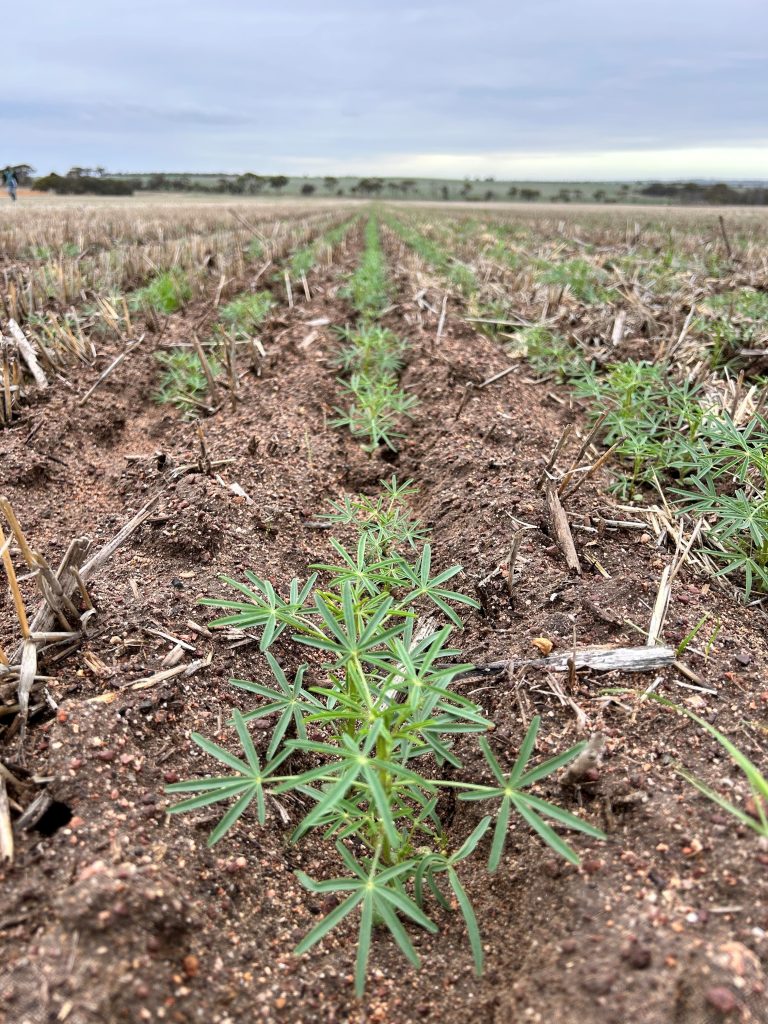
This trial compared the performance of Jurien and the new Rosemont variety under early sowing, with and without soil wetter application. Jurien established more consistently across all plots, but Rosemont achieved higher yields in wetter-treated areas, possibly reflecting its potential in favourable finishes. Both varieties exhibited strong nodulation and good biomass.
Interestingly, wetter treatments showed inconsistent effects, with some improvement in NDVI and yield, but no clear pattern in nodulation. This aligns with broader industry observations that wetters can help, but timing, rainfall, and soil type are critical to success.
Background
WA producers often rely on dry sowing to get their programs underway. This project addresses producer concerns around seed placement, moisture use, variety choice, and early grazing potential. It builds on discussions with local growers, identifying strong confidence in dry seeding canola, oats, barley, and lupins, but knowledge gaps around wetters, nitrogen strategies, and herbicide choice.
Further Information:
Start Date:
End Date:
Funding:
Project Lead:
Project Contact:
Collaborators:
Host Farmers:
July 2023
June 2025
Australian Government’s Future Drought Fund – Extension and Adoption of Drought Resilience Farming Practices
Ag Excellence Alliance
Facey Group – Tina Astbury (eo@faceygroup.org.au)
InterGrain, Seednet, Australian Grain Technologies (AGT), DPIRD
Steve & Robyn Lyneham (Barley Trial)
Graeme & Natalie Manton (Lupin Trial)
Image: AGT new lupin variety, Rosemount, showing good establishment at early establishment counts. June 2024